
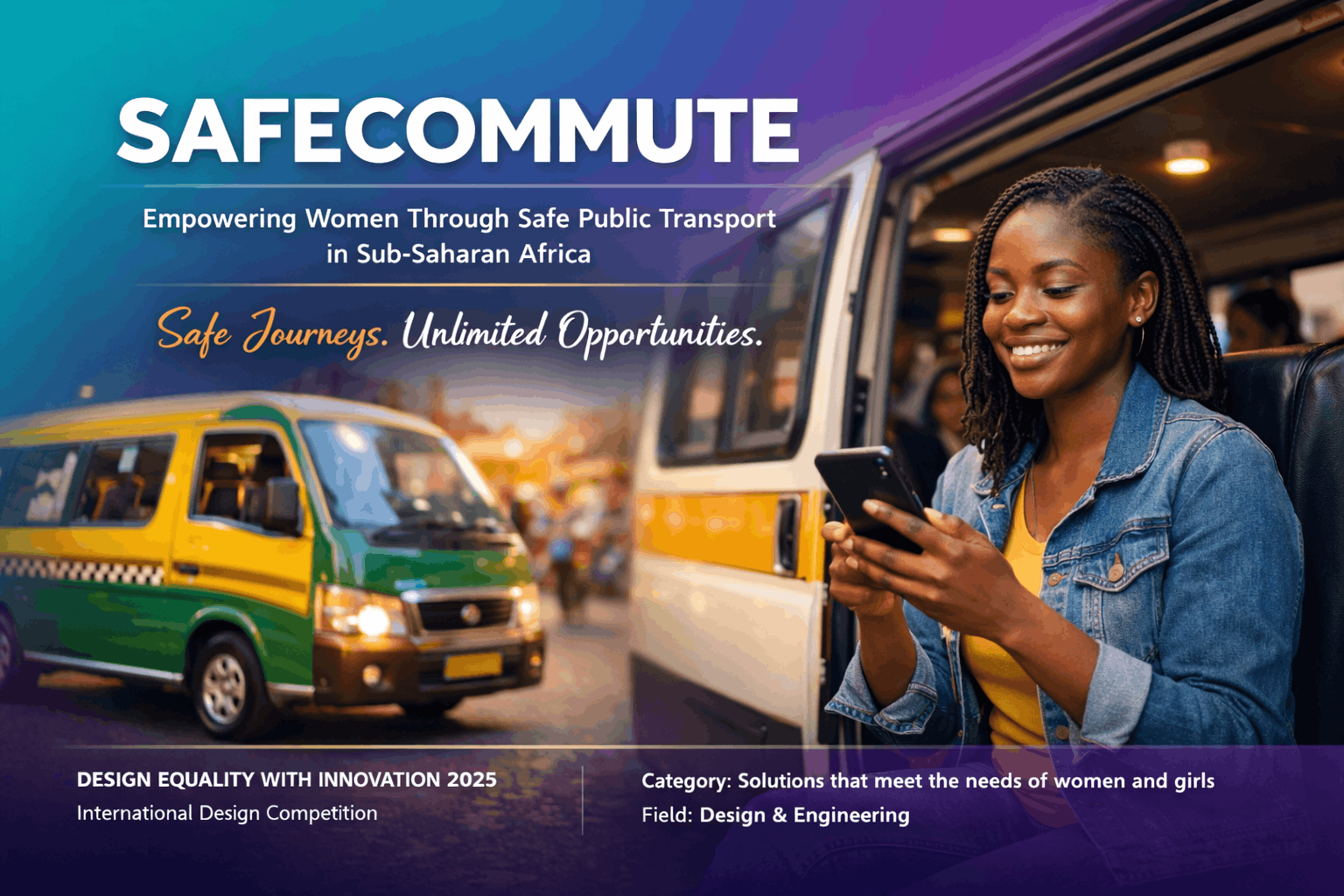
Women globally face harassment and safety threats on public transport, limiting their economic participation. 80% of African women experience harassment in transit, yet 90% go unreported.
SAFECOMMUTE: COMPREHENSIVE PLATFORM FEATURES
FEATURE 1: INTELLIGENT SAFETY MAPPING SYSTEM
Our crowdsourced mapping system allows women across Sub-Saharan Africa to:
– View real-time safety ratings for routes, color-coded (green=safe, yellow=caution, red=avoid)
– Access time-specific data showing routes safe at noon but dangerous at 8pm
– Find well-lit paths, police stations, verified safe havens
– See estimated wait times at matatu stages and taxi ranks
– Predict overcrowding levels on specific routes and times
Technical Implementation: GPS integration, user-contributed data points, machine learning algorithms analyzing patterns, offline map downloads for connectivity-limited areas.
User Experience: Simple, intuitive interface accessible in multiple languages, minimal data usage, works on basic smartphones common across Sub-Saharan Africa.
FEATURE 2: ONE-TAP EMERGENCY RESPONSE
Emergency activation provides:
– Instant alerts to 3-5 pre-selected trusted contacts via SMS and app notifications
– Live GPS location sharing updating every 30 seconds
– Discrete audio/video recording as evidence for authorities
– Direct connection to local emergency services (police, medical)
– Offline functionality storing alerts locally and transmitting when connectivity resumes
Technical Implementation: Background GPS tracking, encrypted data transmission, SMS fallback for areas without data connectivity, battery optimization to ensure functionality even with low power.
Privacy Protection: All emergency recordings encrypted, shared only with user-selected contacts and authorities with user consent.
FEATURE 3: TRANSPARENT ACCOUNTABILITY SYSTEM
Community-driven accountability through:
Anonymous Incident Reporting:
– Location-tagged reports of harassment incidents
– Category classification (verbal, physical, stalking, theft)
– Time and date stamping
– Optional photo/video evidence upload
– Complete anonymity protecting reporters
Transport Operator Ratings:
– Star ratings for matatu drivers, danfo conductors, taxi operators, boda-boda riders
– Written reviews from passengers
– Response from operators addressing concerns
– Aggregated safety scores visible to all users
SafeDriver Verification Program:
– Background checks conducted with transport associations
– Safety training completion requirements
– Minimum rating thresholds
– Verified badge displayed prominently
– Competitive marketplace advantage for certified operators
Data Sharing for Systemic Change:
– Aggregated anonymous data shared with city governments
– Patterns revealed to transport associations
– Evidence for infrastructure investment decisions
– Policy reform proposals based on documented needs
FEATURE 4: JOURNEY SHARING & VIRTUAL ACCOMPANIMENT
Ensuring no woman travels alone:
Live Trip Sharing:
– Select trusted contacts (family, friends, colleagues) before journey
– Real-time location visible to selected contacts
– Estimated arrival time with automatic updates
– Integration with workplace safety protocols
Automatic Safety Alerts:
– Deviation alerts if route changes unexpectedly
– Delay notifications if journey exceeds expected duration
– Stationary alerts if vehicle stops in unexpected location
– Emergency escalation if no response from traveler
“Walk With Me” Virtual Companion:
– Voice/video call option with trusted contact during vulnerable segments
– One-tap emergency activation visible throughout journey
– Psychological comfort of connected presence
– Particularly valuable for walking from taxi rank to final destination
Arrival Confirmations:
– Automatic “I’ve arrived safely” notifications
– Manual confirmation option for final destination
– Peace of mind for families across Sub-Saharan Africa
FEATURE 5: AFFORDABILITY & ACCESSIBILITY SOLUTIONS
Removing economic barriers:
Cost-Optimized Route Planning:
– Multiple route options balancing safety and affordability
– Transparent cost comparisons
– Identification of routes with verified SafeDrivers
– Shared ride matching to reduce individual costs
Offline Functionality:
– Download city maps before traveling
– Store safety ratings for offline access
– Queue emergency alerts for transmission when connected
– Critical for Sub-Saharan Africa’s intermittent connectivity
Multi-Language Support:
– English, Swahili, Yoruba, Zulu, Amharic, French, Portuguese
– Voice-based navigation for users with literacy challenges
– Culturally appropriate terminology and instructions
Low-Data Design:
– Compressed map data
– Efficient GPS tracking
– Optional image quality reduction
– Respecting expensive data costs across Sub-Saharan Africa
BUSINESS MODEL & SUSTAINABILITY
Freemium Structure:
– Core safety features FREE for all women
– Premium features (€2/month): Advanced AI predictions, priority and extended journey history
Corporate Partnerships:
– Companies provide SafeCommute to female employees as safety benefit
– Corporate dashboards showing employee safety metrics
– Workplace safety compliance tool
Municipal Contracts:
– Cities purchase aggregated safety data for infrastructure planning
– Annual subscriptions for data access and analysis
– Evidence-based budgeting for street lighting, police deployment
Revenue Projections:
– Year 1: 2,000 users, focus on free adoption and data collection
– Year 2: 50,000 users, 5% premium conversion, 50 corporate partnerships
– Year 3: 100,000 users, 10 municipal contracts, sustainability achieved
TECHNICAL INFRASTRUCTURE
Platform: Cross-platform mobile app (iOS and Android) built with React Native for efficient development
Backend: Cloud-based architecture ensuring scalability across multiple countries
Data Storage: Encrypted databases complying with regional data protection requirements
GPS Integration: High-accuracy location services with battery optimization
Mapping: OpenStreetMap integration allowing offline functionality
Analytics: Machine learning algorithms identifying harassment patterns and predicting risks
Security: End-to-end encryption for all personal data and emergency communications
PARTNERSHIP STRATEGY
Women’s Organizations:
– Local NGOs in each city for community trust and user recruitment
– Cultural appropriateness consultation
– User feedback and iteration partnerships
Transport Associations:
– Matatu SACCOs (Kenya), Danfo unions (Nigeria), Taxi associations (South Africa)
– SafeDriver program implementation
– Industry buy-in and behavioral change
City Governments:
– Data sharing agreements
– Infrastructure improvement partnerships
– Policy reform collaboration
Technology Partners:
– Mobile network operators for SMS integration
– Mobile money providers for seamless payments
– Cloud infrastructure providers for scalable hosting
MEASURING SUCCESS
Individual Level:
– Number of safe journeys completed
– User-reported anxiety reduction
– Economic opportunities accessed (jobs accepted, events attended)
– App usage frequency and feature adoption
Community Level:
– Harassment incidents reported
– SafeDrivers certified
– Danger zones identified and addressed
– Community engagement metrics
Systemic Level:
– Infrastructure improvements implemented based on data
– Policy changes influenced by evidence
– Transport association training programs launched
– Regional media coverage and awareness
Long-term Impact:
– Women’s labor force participation increases
– Girls’ school attendance improves
– Maternal health outcomes enhance
– Intergenerational mobility pattern transformation
SCALABILITY & REGIONAL EXPANSION
Phase 1 Cities (Proven Diversity):
– Nairobi, Kenya (East Africa, formal matatu system)
– Lagos, Nigeria (West Africa, informal danfo system)
– Kampala, Uganda (East Africa, boda-boda prevalence)
Phase 2 Cities (Regional Coverage):
– Accra, Ghana (West Africa, trotro system)
– Dar es Salaam, Tanzania (East Africa, daladala system)
– Johannesburg, South Africa (Southern Africa, minibus taxi system)
– Kigali, Rwanda (East Africa, emerging BRT system)
– Addis Ababa, Ethiopia (East Africa, formal bus system)
Adaptation Strategy:
– Local women’s organizations lead city-specific customization
– Transport terminology adapted to local names
– Cultural norms respected in reporting mechanisms
– Language support prioritizing local languages
– Mobile money integration with dominant local providers
Regional Bodies Engagement:
– African Union: Gender equality and safe cities initiatives
– East African Community: Regional transport safety standards
– ECOWAS: West African regional policy harmonization
Global Exportability:
– Model proven in Sub-Saharan Africa’s diverse contexts
– Applicable to South Asia, Latin America, Middle East, anywhere women face transport harassment
– Cultural adaptation framework established
– Technology stack scalable globally
SafeCommute transforms Sub-Saharan Africa’s transportation landscape, creating a future where every woman moves freely, safely, and confidently toward unlimited opportunity.
 SafeCommute_file.pdf