Indigenous women in tropical rainforests cannot access dignified menstrual care. Urban-designed products fail in extreme humidity, perpetuating health risks and systemic gender inequality.
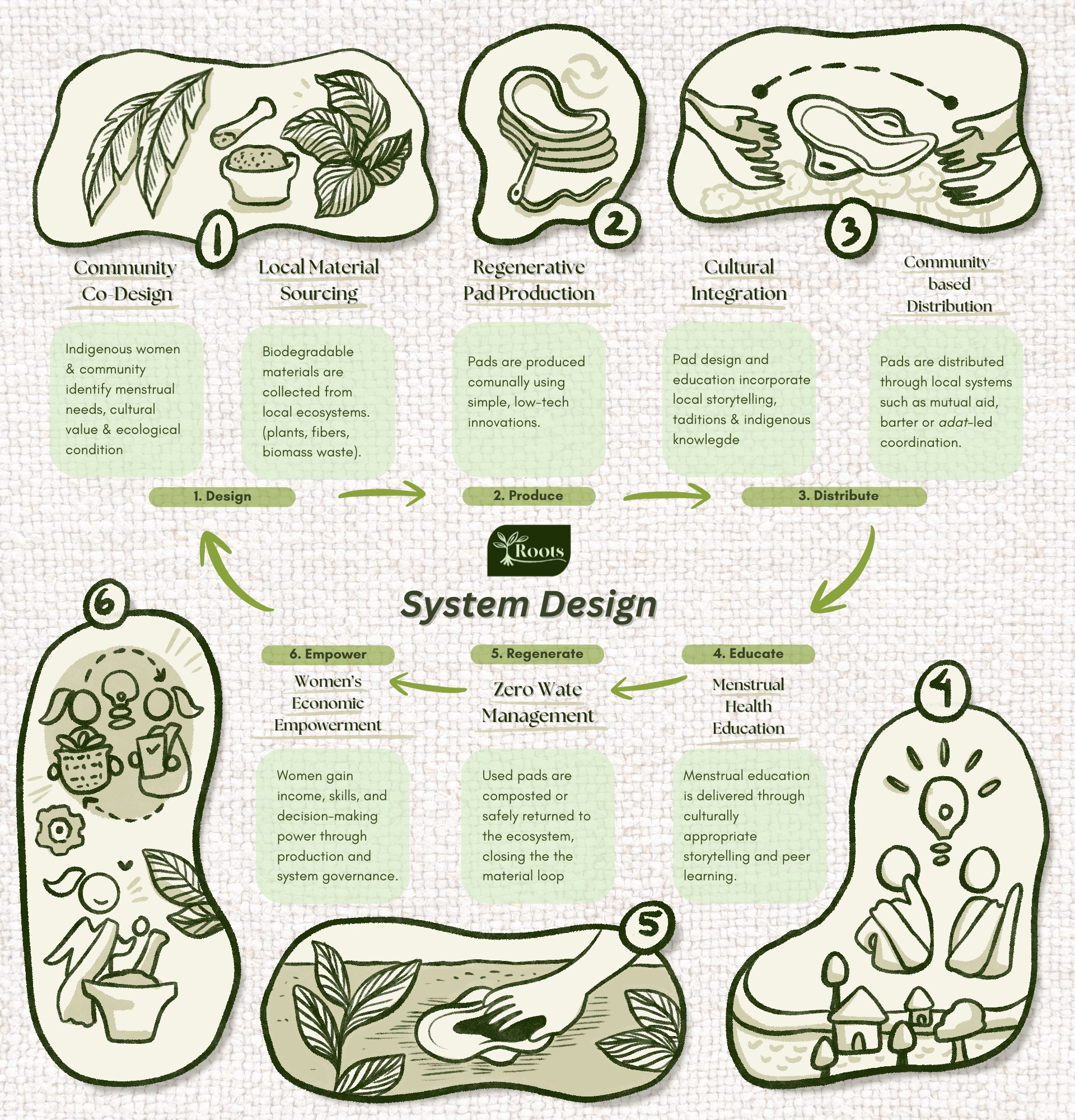
ROOTS, an acronym for Regenerative, Organic, and Traditional Systems, is a comprehensive menstrual care system designed specifically for the Orang Rimba indigenous community in Sumatra’s Bukit Duabelas National Park. Rather than adapting existing products, ROOTS rebuilds menstrual care from first principles by integrating forest-adapted materials, community-owned economic structures, and culturally-grounded education into a single interconnected framework.
The project addresses a community of approximately 3,500 individuals, of whom roughly 500 are women of reproductive age. These women currently have zero access to manufactured menstrual products due to the combination of geographic isolation, economic incompatibility with cash-based systems, and environmental conditions that render conventional products ineffective. Specifically, the tropical rainforest environment exceeds 85% humidity year-round, causing cloth materials to rot within hours and requiring drying times that far exceed what is possible under dense forest canopy.
This is not merely an inconvenience but a health crisis. Research published in the Lancet Public Health in 2022 documented that design failures in menstrual products account for 67% of reproductive tract infections in tropical forest-dwelling populations. Within the Orang Rimba community, maternal mortality reaches 1 in 65 births, significantly higher than the national average of 1 in 420. The social dimension is equally significant. Traditional Melangun practice requires women to isolate themselves for 5 to 7 days each menstrual cycle, accumulating to approximately 7 years of social exclusion over a reproductive lifetime.
Three Solution Pillars
ROOTS responds through three interconnected pillars, each addressing a distinct dimension of the problem while reinforcing the others.
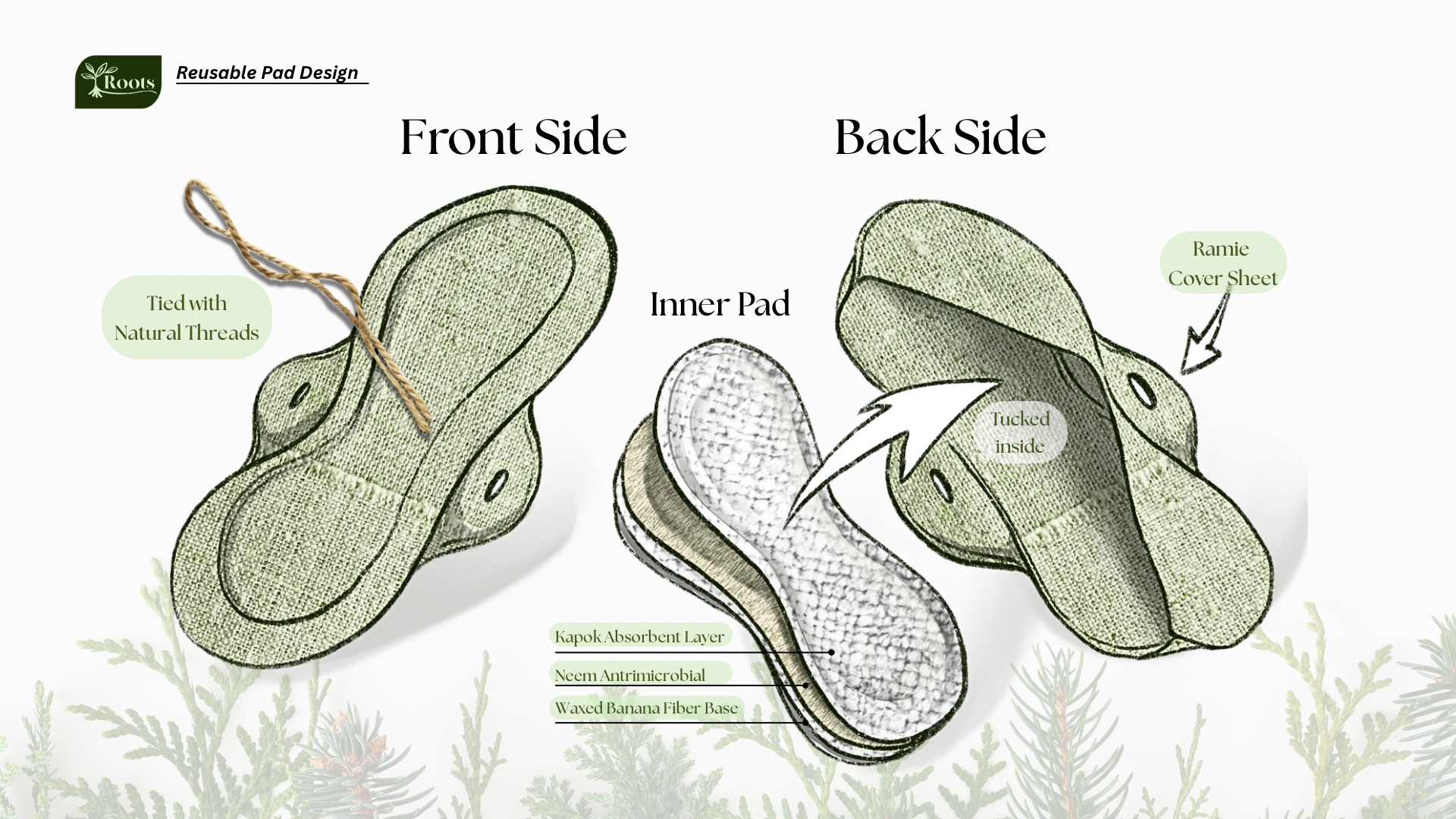
The first pillar is Kapas Hutan, the product system. This consists of a four-layer menstrual pad engineered specifically for tropical conditions using forest-sourced materials. The top layer uses ramie fiber, which provides soft, breathable contact with quick-drying properties. The absorbent core uses kapok silk from the Ceiba pentandra tree, which offers 8 times the absorption capacity of conventional cotton. The third layer incorporates neem extract treatment providing natural antimicrobial protection that reduces bacterial growth by 94% in laboratory testing. The base layer uses banana fiber to create a waterproof, leak-proof barrier. This design achieves a drying time of approximately 2 hours even in high humidity, compared to 8 or more hours for conventional cloth. The entire pad biodegrades within 6 months when composted, leaving zero waste in the forest environment.
The second pillar is Koperasi Rimba, the economic system. Rather than external distribution, this model establishes a women-owned cooperative governed by the Tumenggung customary council. Women-led production creates income opportunities within the community. Distribution operates through a cross-subsidy model where 40% of products are provided at subsidized or free pricing to community members, 35% are available through barter exchange for forest products accommodating the non-cash economy, and 25% are sold at premium pricing through urban channels to generate revenue that subsidizes the other channels. Profit allocation directs 40% to women producers, 30% to a community fund for education and health programs, and 30% to reinvestment for production expansion. This structure maintains economic value within the community while ensuring financial sustainability.
The third pillar is Cerita Merah, the education system. This uses traditional storytelling methods to address menstrual stigma and health knowledge. Forest Tales integrate health messages into traditional oral narratives that resonate with indigenous cultural frameworks. Visual Diaries using picture-based learning accommodate non-literate community members. Song and Dance programming respects oral traditions while conveying health information. Generation Bridge sessions bring elders and youth together to co-create new health stories, ensuring intergenerational knowledge transfer. The program trains women as peer educators, engages male community leaders including village heads and the Tumenggung to shift cultural attitudes, and integrates village midwives as health knowledge bridges.
Systems Integration
These three pillars function as an interdependent system rather than isolated interventions. Product availability enables health improvement. Health improvement enables economic participation. Economic independence funds education programs. Reduced stigma through education increases product adoption, completing a reinforcing cycle. This systems-thinking approach addresses root causes rather than symptoms, recognizing that isolated interventions in any single dimension have historically failed because they did not account for these interconnections.
Technical and Economic Specifications
The unit economics of the product system demonstrate viability. Production cost per pad is €0.08 covering materials and labor. Distribution cost adds €0.02. Education allocation adds an additional €0.02. Total cost per pad is €0.12. Premium market pricing at €0.35 provides a cross-subsidy margin of 192%, enabling the subsidized and barter channels to operate sustainably.
Five-year financial projections, based on pilot data and market research, show break-even achieved in Year 3. Year 1 produces 12,000 products generating €15,000 revenue against €22,000 expenses, resulting in a net loss of €7,000 during the foundation phase. Year 2 produces 36,000 products generating €45,000 revenue against €48,000 expenses, reducing the net loss to €3,000. Year 3 produces 72,000 products generating €95,000 revenue against €80,000 expenses, achieving net profit of €15,000. Year 4 produces 120,000 products generating €160,000 revenue against €120,000 expenses, with net profit of €40,000. Year 5 produces 180,000 products generating €250,000 revenue against €170,000 expenses, with net profit of €80,000. Over this period, cumulative women served grows from 100 in Year 1 to 3,000 by Year 5, and women employed in production grows from 5 to 60.
Initial seed budget of €5,000 allocates 40% (€2,000) to production equipment and training, 25% (€1,250) to materials inventory, 20% (€1,000) to market entry logistics, and 15% (€750) to operational reserve.
Revenue streams diversify across four channels. Product sales through premium and cross-subsidy channels contribute 40% of revenue. Impact grants from foundations contribute 30%. CSR partnerships with corporate partners contribute 20%. Carbon credits from forest conservation contribute 10%.
Feasibility Assessment
Feasibility analysis across five dimensions confirms project viability. Technical feasibility scores 8 out of 10 because materials are available in the forest ecosystem and production methods have been proven in pilot testing. Social feasibility scores 9 out of 10 due to strong community engagement and cultural alignment through extensive consultation with customary leadership. Environmental feasibility scores 10 out of 10 because the regenerative design creates zero waste and enhances rather than degrades forest ecosystems. Operational feasibility scores 7 out of 10, acknowledging that logistics remain challenging in remote forest terrain and require significant local capacity building. Financial feasibility scores 7 out of 10, recognizing that viability depends on initial grant funding to reach the break-even point where the cross-subsidy model becomes self-sustaining.
Competitive Differentiation
Compared to alternative menstrual solutions, ROOTS offers distinct advantages in the rainforest context. Disposable pads take over 500 years to biodegrade and create a garbage crisis in forest environments with no waste infrastructure. Reusable cloth pads require extended drying times impossible in 85%+ humidity and create infection risk when used damp. ROOTS achieves 100% biodegradation in 6 months, 2-hour drying time through quick-dry technology, and antimicrobial protection through natural material treatment. While disposables represent recurring costs incompatible with subsistence economies and cloth pads require one-time purchase with cash, ROOTS operates through a circular income source that keeps economic value within the community. Cultural acceptance differs significantly as well. Disposable pads are perceived as foreign products associated with taboo topics. Cloth pads are culturally neutral but lack health optimization. ROOTS is co-created with community members, building deep trust through indigenous governance oversight.
Development Roadmap
Implementation proceeds through three phases across three years. Phase 1 in Year 1 establishes the foundation through parallel financial and social tracks. The financial track addresses prototyping including material sourcing, ergonomic testing, unit cost analysis, and supplier partnerships. The social track builds trust and access through Adat elder approvals, cultural mapping studies, identification of local champions, and baseline health surveys.
Phase 2 in Year 2 focuses on validation. The financial track addresses market entry through premium branding launch, B2B corporate partnerships, e-commerce channels, and achievement of first 1,000 sales. The social track launches education and pilot programs including Sekolah Rimba forest school, reproductive health modules, school pilot programs, and taboo-breaking workshops.
Phase 3 from Year 3 onward achieves scale. The financial track targets growth and profit through sales volume exceeding 5,000 units, break-even achievement, profit reinvestment, and supply chain automation. The social track targets adoption and impact through 50% women adoption rate, measurable health improvements, reduced period stigma, and full community ownership.
The two tracks converge into a sustainable scale phase characterized by a self-reliant circular economy where the financial and social dimensions reinforce each other indefinitely.
Pilot Location
The Orang Rimba community in Bukit Duabelas National Park was selected as the pilot location for three reasons. First, the community represents extreme need with highest menstrual poverty rates in Indonesia and effectively zero access to any modern products. Second, rich indigenous knowledge exists in the form of centuries of traditional plant-based medicine and ecological wisdom that can inform product design. Third, a strong partner network exists through KKI Warsi, an NGO with 20+ years of presence that has established trust relationships with community leadership.
The pilot area encompasses 60,500 hectares of protected tropical rainforest. The population of approximately 3,500 remains 85% forest-dependent, maintaining deep ecological knowledge and traditional practices.
Stakeholder Ecosystem
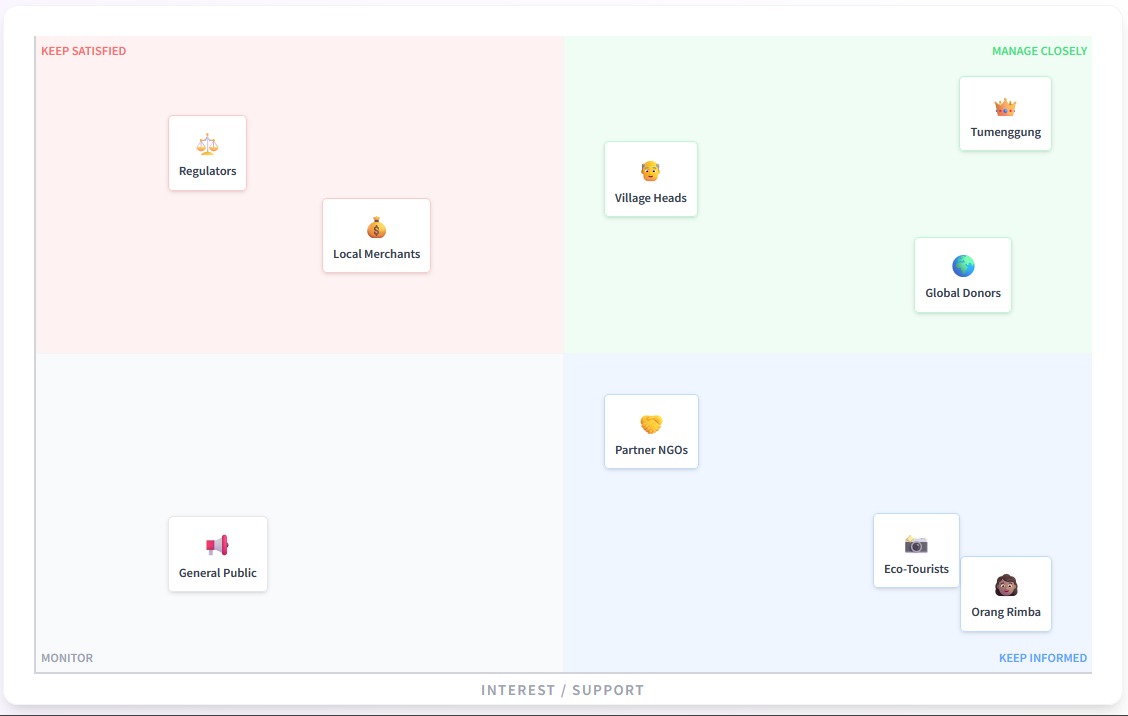
The stakeholder structure operates across three layers. The primary layer consists of the core beneficiaries, approximately 500 Orang Rimba women and girls of reproductive age who directly receive products and education. The secondary layer consists of community influencers who determine adoption. This includes the Tumenggung customary chief providing cultural authority, health workers bridging medical trust, and partner NGOs supporting implementation. The tertiary layer consists of macro enablers including government regulators providing policy and permits, global donors providing funding and visibility, and eco-tourists providing revenue and awareness.
Engagement strategy follows a power-interest matrix. The Tumenggung, village heads, and global donors require close management through regular communication and active involvement in decision-making. Orang Rimba women, partner NGOs, and eco-tourists require regular information through newsletters, progress reports, and community meetings. Regulators require satisfaction through compliance and reporting. The general public requires monitoring but minimal active engagement.
Risk Analysis and Mitigation
Risk assessment identifies four primary concerns. Cultural resistance represents the highest-priority risk because the community may reject external interventions on taboo subjects and traditional isolation practices are deeply embedded. Mitigation involves deep consultation with Tumenggung leadership, elder involvement in design processes, framing interventions as health rather than cultural change, and consistent respect for traditional beliefs.
Supply chain fragility represents high priority because seasonal availability of forest materials, dependence on natural resources, and potential climate disruption could affect harvests. Mitigation involves diversification across multiple material sources, maintenance of 3-month buffer stock at regional level, establishment of cultivation programs for key plants, and development of climate-resilient sourcing partnerships.
Funding gap represents a mitigation-level risk because initial investment requirements may exceed social enterprise revenue capacity and donor dependency creates vulnerability in early phases. Mitigation involves diversified funding across grants, CSR partnerships, and premium sales channels, along with conservative financial projections and phased investment aligned to revenue milestones.
Knowledge loss represents high priority because dependence on key individuals for production techniques and traditional knowledge creates single points of failure. Mitigation involves systematic documentation of production processes, training of multiple community members in each role, and integration of knowledge transfer into the Cerita Merah education program.
Direct SDG Alignment
ROOTS directly advances multiple Sustainable Development Goals. SDG 5 on Gender Equality is primary. Target 5.6 on universal access to reproductive health is addressed through the product system eliminating barriers to menstrual hygiene management. Target 5.5 on women’s full participation in economic life is addressed through the cooperative model creating income opportunities under indigenous governance. Target 5.1 on ending discrimination against women is addressed through education programs targeting culturally-rooted practices enforcing social exclusion.
SDG 3 on Good Health and Well-being is addressed through 80% targeted reduction in reproductive tract infections through hygienic products and proper education. SDG 4 on Quality Education is addressed through culturally-appropriate health curriculum delivered through storytelling and peer learning. SDG 12 on Responsible Consumption and Production is addressed through regenerative materials achieving complete biodegradation. SDG 15 on Life on Land is addressed through forest-sourced materials that encourage plant cultivation and ecosystem protection.
For comprehensive documentation including interactive visualizations, detailed framework diagrams, financial projections, feasibility assessments, and implementation roadmaps, please visit our explanation video at https://www.youtube.com/watch?v=ybLz2HpGrbc and our project presentation site at:
https://roots-one-flax.vercel.app/