

Women facing gender-based violence often can’t safely seek help due to surveillance, stigma, and lack of privacy. Most tools increase risk and exclude women without smartphones or internet.
1. Introduction and System Overview
HerHaven is a discreet, telecom‑first support and escalation system designed for women living under surveillance, isolation, or coercive control. Globally, women experiencing intimate partner violence (IPV) (also known as gender based violence(GBV)) and related forms of abuse face persistent structural and social barriers to help‑seeking, including stigma, fear of retaliation, economic dependence, and low trust in formal institutions. These barriers are particularly severe in contexts where women’s access to private communication is limited or actively monitored.
Many existing digital safety interventions implicitly assume access to smartphones, stable internet connectivity, and private screen space. However, prior research demonstrates that visible applications, call logs, notifications, and stored digital artifacts can significantly increase risk for survivors whose technology use is surveilled by abusive partners. In such environments, the very tools intended to provide protection may instead facilitate monitoring, coercion, and retaliation.
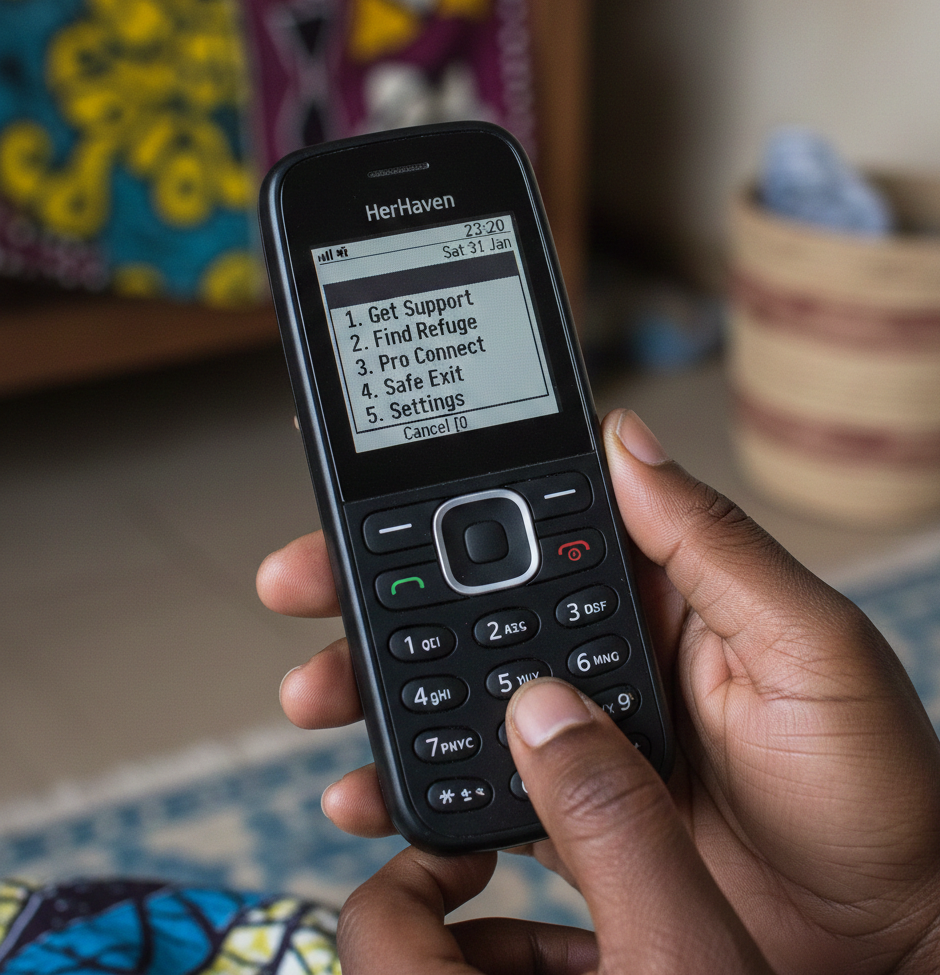
HerHaven addresses this gap by enabling anonymous, low‑visibility access to support through USSD codes, SMS messages, and missed calls—communication channels that are widely available, low‑cost, and culturally normalized across sub‑Saharan Africa. The system is intentionally designed to prioritize safety, autonomy, and privacy. It does not require users to disclose personal information for basic access, does not store device‑side artifacts, and does not mandate escalation to authorities. Instead, HerHaven provides women with consent‑driven pathways to emotional stabilization, nearby refuge locations, and professional assistance when and if they choose to engage.
2. Problem Statement and Evidence of Need
Intimate partner violence constitutes a persistent public health and human rights crisis in sub‑Saharan Africa (SSA), where prevalence rates remain higher than the global average and access to support services is limited. While the occurrence of IPV is widely documented, a critical and under‑addressed challenge lies in women’s inability or unwillingness to seek help after experiencing violence.
Recent multi‑country evidence indicates that approximately 60.7% of women in SSA who experienced IPV did not seek help from any source, formal or informal. In some countries, such as Mali, non‑help‑seeking exceeds 80%, while even in lower‑prevalence contexts such as Tanzania, more than 40% of survivors remain unsupported. These patterns persist across rural and urban settings and among women with secondary education or higher wealth status, undermining assumptions that economic resources or education alone ensure access to safety.
Social norms and lived experiences further compound these barriers. Women exposed to intergenerational violence or those who internalize norms justifying wife‑beating are significantly less likely to seek help following IPV. In such contexts, disclosure may be perceived as socially costly, dangerous, or futile. At the same time, technology has emerged as a double‑edged factor: while it offers potential pathways to assistance, it has increasingly been exploited by abusers to monitor, isolate, and control survivors, particularly during periods of heightened vulnerability such as the COVID‑19 pandemic.
The consequences of sustained non‑help‑seeking are severe. Survivors remain exposed to repeated violence, leading to long‑term physical injury, psychological trauma, adverse health outcomes, and the perpetuation of intergenerational cycles of abuse. Despite this reality, many IPV interventions in SSA continue to rely on self‑initiated reporting, physical mobility, or direct engagement with authorities—approaches that systematically exclude women who cannot safely disclose abuse.
These conditions underscore the need for discreet, low‑risk, and autonomy‑preserving support systems that enable women to signal distress without escalating danger. Telecom‑based systems that rely on non‑intrusive communication channels and community‑embedded refuge points are essential to addressing the structural, social, and technological barriers that currently prevent women in SSA from seeking help.
3. Target Audience
The primary users of HerHaven are women living under coercive control, surveillance, or social isolation, particularly those with limited access to smartphones, private internet connectivity, or digital literacy. This includes women in rural settings, low‑income environments, and culturally restrictive contexts where help‑seeking may be stigmatized or punished.
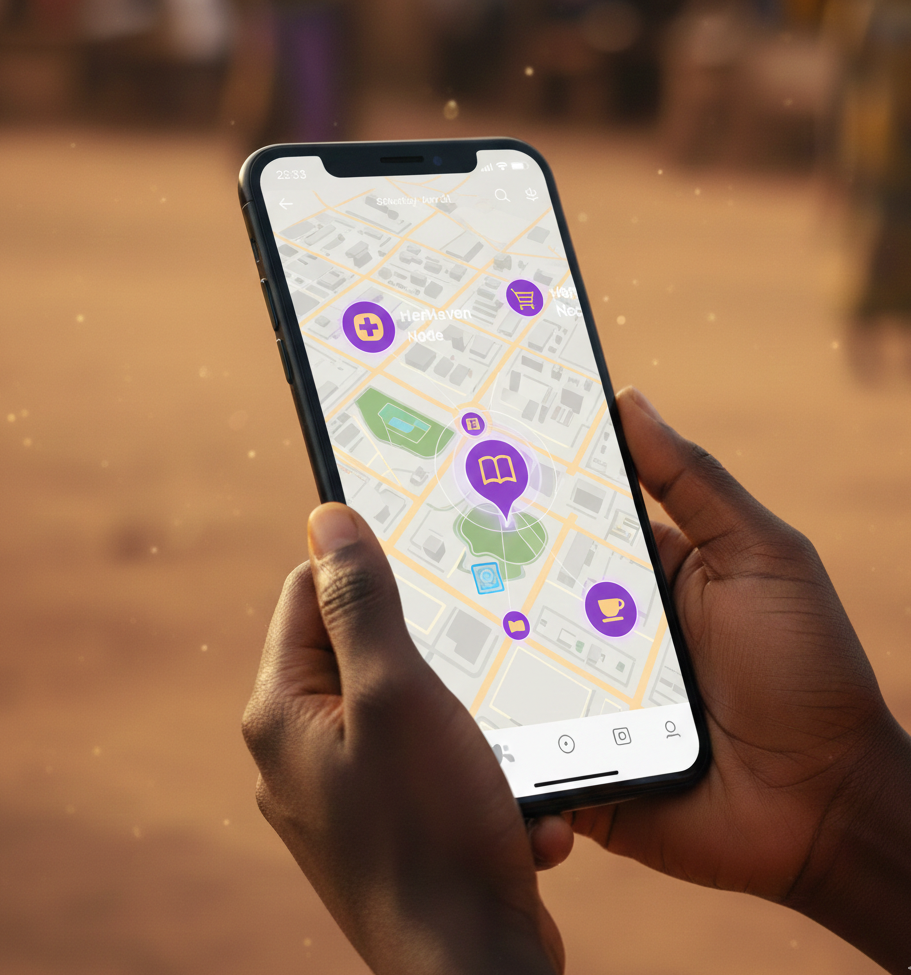
Secondary users include trained volunteers who provide remote emotional stabilization and support, as well as verified professional responders such as healthcare workers and psychosocial practitioners. Community partners—including clinics, pharmacies, shops, and community centers—serve as HerHaven Nodes, embedding safe refuge points within everyday environments to reduce suspicion and increase accessibility.
4. System Purpose and Design Rationale
HerHaven is designed to function invisibly and safely within the constraints faced by its users. Its purpose is not to label, diagnose, or confront abuse, but to provide discreet access to support options that do not increase risk. User autonomy is central to the system: escalation, follow‑up, and disclosure occur only with explicit consent.
The system follows trauma‑informed and safety‑by‑design principles. Prior research cautions that poorly designed digital interventions can inadvertently expose survivors through persistent logs, notifications, or inappropriate escalation assumptions . HerHaven mitigates these risks through minimal data collection, neutral language, and fail‑safe defaults that prioritize user safety over response speed.
5. Functional Architecture
HerHaven accepts distress signals through USSD sessions, SMS messages, and missed calls. These channels were selected because they function on basic mobile phones, require minimal technical skill, and can be used without generating visible device‑side records. Incoming signals are processed through a telecom gateway that assigns timestamped, anonymized case identifiers while minimizing retention of personally identifiable information.
A rules‑based alert and escalation engine determines appropriate response tiers. Low‑risk cases may receive remote stabilization support from trained volunteers, while higher‑risk cases may trigger guidance to nearby HerHaven Nodes or escalation to professional responders. Escalation logic is configurable to accommodate regional legal requirements and cultural norms.
HerHaven Nodes consist of pre‑verified refuge locations embedded in everyday spaces. Proximity guidance relies on network‑level or cell‑tower estimation rather than GPS, disclosing exact locations only with explicit user consent. This approach balances physical safety with privacy preservation.
6. Data Use, Privacy, and AI
HerHaven employs server‑side analytics solely for aggregated insights such as temporal demand patterns, regional resource gaps, and system performance metrics. No individualized behavioral prediction, profiling, or surveillance is performed. This design choice responds directly to documented risks of data misuse and secondary harm in survivor‑focused technologies .
All data in transit and at rest is protected using end‑to‑end encryption, and data retention is minimized by default. Temporary case records automatically expire unless the user explicitly opts into follow‑up, aligning the system with privacy‑by‑design principles.
7. Ethical, Legal, and Cultural Considerations
Ethically, HerHaven is designed to minimize secondary harm caused by technology. Research on digital safety systems for survivors emphasizes the risks of forced reporting, visible alerts, and rigid escalation pathways that can expose users to retaliation . HerHaven avoids law‑enforcement‑first defaults and prioritizes informed consent.
Legally, the system is adaptable to regional telecom regulations, data‑protection frameworks, and mandatory reporting laws. Escalation pathways can be configured to comply with local legal obligations while preserving user choice wherever permissible.
Culturally, HerHaven acknowledges that perceptions of abuse, authority, and help‑seeking vary across societies. Localization, language adaptation, and partnerships with trusted community institutions are therefore essential to deployment, ensuring cultural relevance without reinforcing harmful norms.
8. Competitive and Landscape Analysis
Existing interventions such as crisis hotlines, SMS‑based support services, and smartphone safety applications demonstrate the feasibility of remote assistance but remain constrained by assumptions of privacy, connectivity, and willingness to engage authorities. Anonymous SMS services validate the effectiveness of low‑barrier communication but typically do not support discreet physical relocation or proximity‑based refuge guidance.
Many safety applications require installation, visible icons, or persistent notifications, rendering them unsuitable for users under device surveillance . HerHaven differentiates itself through its telecom‑first, no‑app architecture; consent‑driven escalation model; and integration of community‑embedded HerHaven Nodes. These features position the system as a complementary layer within the broader survivor‑support ecosystem.
9. Evaluation and Success Metrics
System performance will be evaluated using metrics including the number of unique distress signals received, average response time, utilization rates of HerHaven Nodes, volunteer engagement levels, and the proportion of interactions conducted via basic mobile phones. Safety audits will track adverse outcomes, with iterative refinement to maintain a zero‑harm objective.
10. Conclusion
HerHaven offers a privacy‑preserving and culturally adaptable approach to supporting women who cannot safely access traditional help channels. By leveraging ubiquitous telecom infrastructure and embedding refuge within everyday spaces, the system addresses a critical gap in survivor‑support ecosystems in sub‑Saharan Africa. Its emphasis on discretion, autonomy, and ethical design positions HerHaven as a scalable and responsible intervention for high‑risk contexts.
 DESIGN EQUALITY- HerHaven.pdf