
Gender gap in tech: Women lack laptops, internet, face language barriers and cultural exclusion from tech education. Only 57% use smartphones for learning; 70%+ dropout rates deny economic opportunity
Efiwe is an AI-powered mobile coding education platform engineered to democratize technology skills for women and girls in emerging markets who have been systematically excluded from digital economy opportunities. The platform teaches coding through ~1,000 interactive challenges, enabling learners to build professional websites entirely on smartphones without laptops or constant internet connectivity.
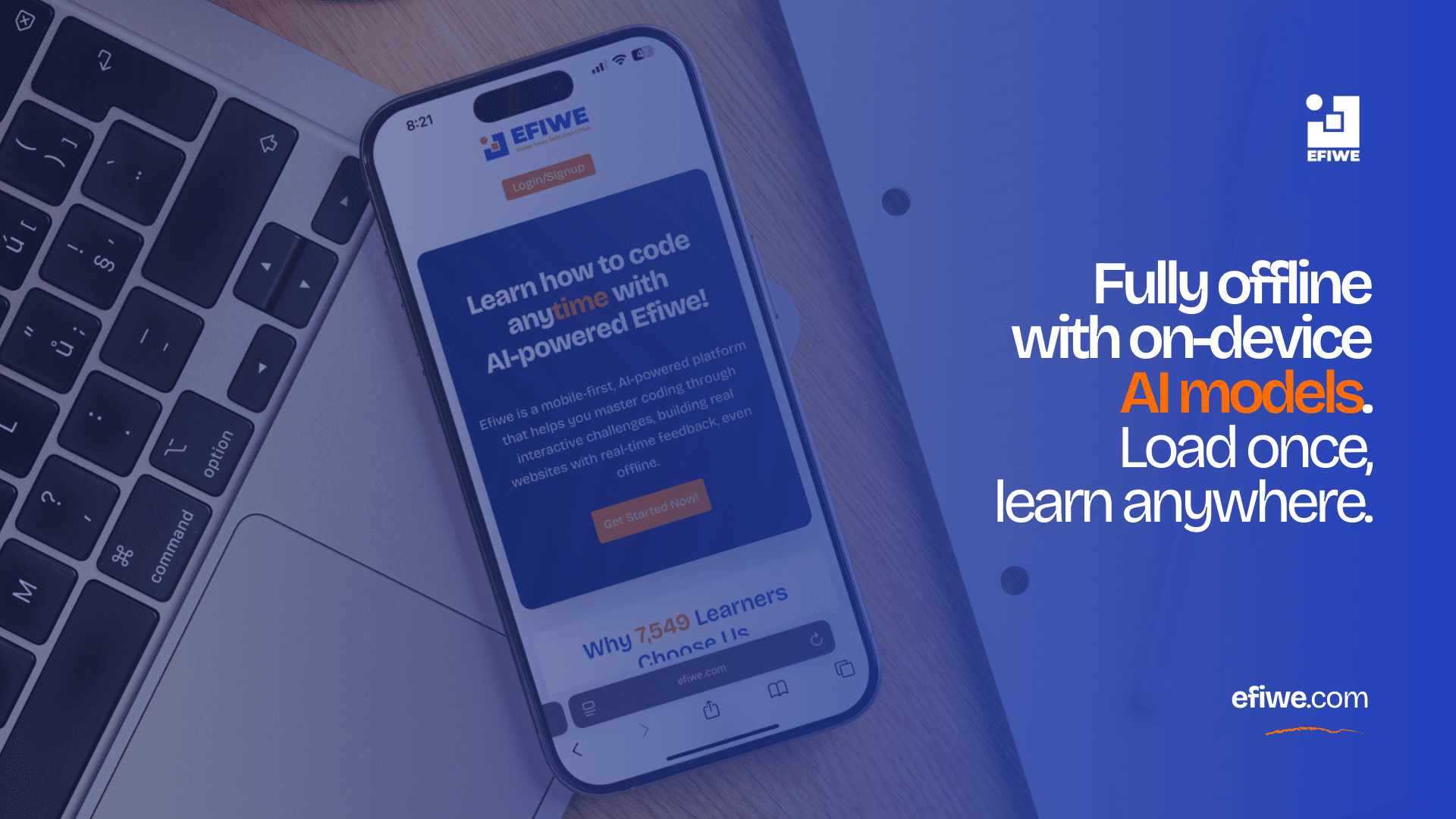
The technical architecture addresses the specific constraints women face in resource-limited environments. A dual AI system combines an advanced lightweight TensorFlow-based model that runs entirely on-device for offline learning with a more advanced cloud-based model for enhanced feedback when connectivity is available. This ensures women can learn during any available moment regardless of internet access or data costs. The offline AI analyzes code in real-time, detects mistakes, prioritizes the most important issues, predicts helpful hints based on previous errors, and adjusts difficulty dynamically, all without requiring cloud connectivity or data transmission.
The platform’s 189-language support with voice-based learning removes literacy and English-proficiency barriers that disproportionately affect women in developing regions due to historical educational inequities. Text-to-speech technology delivers instructions, feedback, and guidance with adjustable speed and tone, making coding accessible even for learners with dyslexia or limited reading skills. This voice capability is particularly crucial in contexts where women have lower formal education levels but possess strong verbal communication and problem-solving abilities.
Gamification transforms learning from intimidating technical training into an engaging, achievement-oriented experience. Learners earn badges, build streaks, unlock levels, and receive encouraging feedback that builds confidence incrementally. This design acknowledges research showing women often underestimate their technical abilities and benefit from frequent positive reinforcement and visible progress markers. The challenge-based structure with immediate feedback creates a judgment-free environment where mistakes become learning opportunities rather than sources of shame or discouragement.
Group account functionality enables women-focused organizations, girls’ schools, community centers, and female entrepreneurship programs to enroll learners, monitor progress through dashboards, and run structured coding programs without requiring computer labs or dedicated learning spaces. This is transformative for contexts where women cannot easily access or afford formal training centers. NGOs working with rural women, refugee programs serving displaced women and girls, and community initiatives focused on female empowerment can now deliver high-quality coding education using only smartphones and Efiwe’s platform.
Since launching in August 2025, Efiwe has reached ~9,000 learners across 120+ countries with 89% satisfaction rates and 100% recommendation rates among surveyed users. The platform has successfully piloted with hundreds of students in rural Nigerian and Indian schools through partnerships with organizations including Kalpavriksha Sustainable Development Society and PM SHRI Kendriya Vidyalaya. Early adopters include women who explicitly noted that Efiwe’s mobile-first, offline design finally made coding education accessible within their life constraints.
The platform issues verifiable certificates with QR codes that employers can scan to instantly confirm authenticity, addressing the credibility gap women face when presenting self-taught skills. This verification system removes gatekeepers and bureaucratic barriers that often disadvantage women lacking traditional credentials or professional networks. Women can learn at their own pace, earn recognized credentials, and present verified skills directly to employers or clients without requiring institutional endorsement.
Efiwe’s recently launched Open API extends impact by enabling women-focused training programs, NGOs, and educational institutions to embed interactive coding challenges directly into their own platforms and curricula. This white-label capability allows organizations already trusted by women in their communities to deliver coding education without building technical infrastructure from scratch, dramatically expanding reach and cultural appropriateness of technology training for women.
Efiwe directly advances multiple Sustainable Development Goals beyond SDG 5 on gender equality. It supports SDG 4 on quality education by providing accessible, effective learning regardless of geography or resources. It advances SDG 8 on decent work and economic growth by equipping women with skills for higher-earning technology careers. It contributes to SDG 10 on reduced inequalities by removing barriers based on device ownership, connectivity, language, and literacy. It supports SDG 9 on industry, innovation, and infrastructure by building human capacity for technology entrepreneurship in underserved regions.
By transforming smartphones into coding classrooms, Efiwe fundamentally redefines who can become a technology creator. Women managing households, caring for children, living in rural areas, speaking minority languages, or lacking formal education can now access the same quality coding education as privileged learners with laptops and high-speed internet. This isn’t just skills training but a pathway to economic independence, entrepreneurship, and participation in the global digital economy on equal terms.
 Efiwe — Future Skills Program Report.pdf