
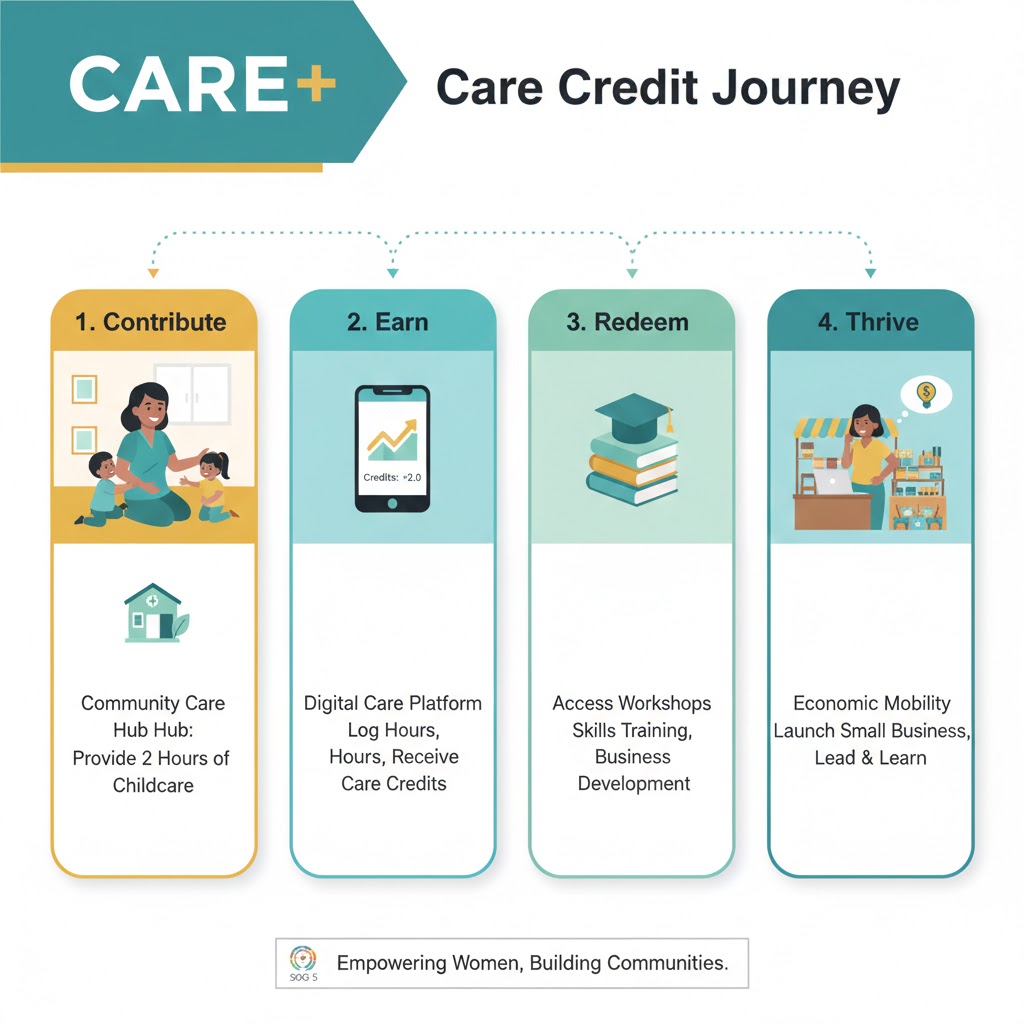
CARE+ is an innovative, gender-inclusive design concept that addresses unpaid care work as a key driver of gender inequality.
Problem Statement
Unpaid care work, including childcare, elder care, care for people with disabilities, and routine domestic responsibilities, is one of the most significant yet least recognised forms of labour in the global economy. Across regions, cultures, and income levels, this work is performed disproportionately by women and girls. International research by organisations such as UN Women and the International Labour Organization consistently shows that women perform more than three-quarters of the world’s unpaid care work, often spending two to five times more hours per day on care-related tasks than men. Despite being essential to the functioning of families, communities, and national economies, unpaid care work remains largely invisible in policy frameworks, economic statistics, and innovation systems. Because it is not formally paid or recorded, it is often treated as a private responsibility rather than a public concern. This invisibility reinforces the idea that care is a “natural” role for women rather than a form of labour that requires recognition, support, and redistribution.
The unequal distribution of unpaid care work has far-reaching consequences for gender equality. Women with heavy care responsibilities have less time and flexibility to pursue education, skills development, formal employment, entrepreneurship, or participation in innovation ecosystems. Many are forced into informal or precarious work that can be combined with care duties but offers low pay, limited security, and few opportunities for advancement. For girls, early involvement in household care can reduce school attendance and learning outcomes, reinforcing intergenerational cycles of inequality. The problem is especially acute for low-income women, single mothers, migrant women, and those working in the informal sector. These groups often lack access to affordable childcare, elder care services, or social protection systems. As a result, unpaid care work becomes a major barrier to economic independence and social mobility. Without deliberate and innovative interventions that recognise, reduce, and redistribute care work, gender inequality will continue to be reproduced across social and economic systems. CARE+ responds directly to this challenge by addressing unpaid care work not as an individual issue, but as a structural and systemic problem that requires design-led, community-based, and technology-supported solutions.
Target Group
CARE+ is designed to serve women and communities that are most affected by the unequal burden of unpaid care work. The primary target groups include:
• Low-income and working women who must balance income-generating activities with extensive care responsibilities.
• Single mothers and primary caregivers often carry sole responsibility for both earning income and providing care.
• Women in informal or precarious employment, including domestic workers, market traders, and home-based workers, who lack access to employer-supported care services.
• Community-based women’s groups and cooperatives that already play an informal role in mutual support and care provision.
The concept is particularly relevant in urban and peri-urban areas where rapid urbanisation, rising living costs, and limited public care infrastructure increase pressure on households. However, CARE+ is designed to be adaptable and can be applied in rural settings with appropriate contextual adjustments.
By focusing on women who are most constrained by unpaid care responsibilities, CARE+ aims to deliver meaningful and measurable improvements in time use, economic participation, and overall well-being.
Proposed Solution: CARE+
CARE+ is a design-led social innovation concept that reimagines unpaid care work as a shared, visible, and supported system rather than an individual burden borne by women. The solution combines community-based care infrastructure with a simple digital coordination platform to create an integrated care ecosystem.
The core idea behind CARE+ is that care work should be treated as essential social infrastructure—similar to transport, water, or energy systems—and designed accordingly. By organising care collectively and supporting it with technology, CARE+ reduces pressure on individual women while creating new opportunities for employment, leadership, and innovation.
Key Components
Community Care Hubs
Community Care Hubs are the physical foundation of the CARE+ system. These are locally organised, accessible spaces within neighbourhoods where trained caregivers provide essential care services, including:
• Childcare for infants and young children
• Elder care and support for older adults
• Short-term domestic assistance for households facing temporary care needs
The hubs are designed to be safe, inclusive, and culturally appropriate. They operate on flexible schedules to accommodate women’s varied working hours and responsibilities. Importantly, the hubs are co-managed and staffed by women from the community, creating local employment opportunities and strengthening social cohesion.
Evidence from community-based care models around the world shows that shared care services can significantly reduce women’s unpaid care burden while improving care quality and accessibility. By locating services within communities, CARE+ reduces travel time and costs, making care support more accessible to low-income households.
Digital Care Exchange Platform
Supporting the physical hubs is a simple, mobile-based digital platform that coordinates care services and recognises care contributions. The platform allows women to:
• Schedule and book care services at local hubs
• Offer care time or skills to others within the network
• Track hours contributed or received
Through this system, women earn care credits for the time and skills they contribute. These credits can be redeemed for a range of benefits, such as:
• Skills training and education programmes
• Business development and entrepreneurship support
• Transport subsidies or mobility support
• Health, childcare, or education services
The digital platform is intentionally designed to be user-friendly and accessible on basic mobile devices, recognising that smartphone and internet access may be limited in some contexts. Where digital access is constrained, hub coordinators can support offline participation and data entry.
Recognition of Care as Economic Infrastructure
A key innovation of CARE+ is its explicit recognition of care work as economic and social infrastructure. By tracking care contributions and participation, the system generates data that can be used to:
• Demonstrate the economic value of care work
• Inform local and national policy discussions
• Support advocacy for increased investment in care services
This recognition challenges long-standing norms that devalue care work and helps shift perceptions among policymakers, communities, and development actors.
Innovation and Design Approach
CARE+ applies service design and systems thinking to a deeply gendered and structural problem. Rather than focusing solely on individual behaviour change, the concept redesigns the environment in which care work takes place. The innovation lies in several key areas:
• Visibility: Making care work visible and measurable through shared systems and digital tools.
• Redistribution: Encouraging collective responsibility for care through community-based models.
• Integration: Linking care provision to education, entrepreneurship, and economic opportunity.
• Participation: Positioning women as designers, managers, and decision-makers within the system.
By combining physical spaces with digital coordination, CARE+ bridges the gap between traditional community support mechanisms and modern innovation ecosystems. This hybrid approach increases resilience and adaptability while maintaining a strong human-centred focus.
Gender Equality and Women’s Empowerment Impact
CARE+ directly addresses structural barriers to gender equality by transforming how care work is organised and valued.
The expected impacts include:
• Reduced unpaid care burden: Shared services reduce the number of hours women spend on unpaid care tasks.
• Increased time autonomy: Women gain time for education, skills development, paid work, and innovation.
• Economic empowerment: Paid roles within care hubs and access to training and entrepreneurship support increase income opportunities.
• Leadership and agency: Women’s involvement in managing and governing care hubs strengthens leadership skills and community influence.
Research consistently shows that when women gain control over their time and economic resources, there are positive spillover effects for families, communities, and broader development outcomes. CARE+ leverages these dynamics to create sustainable, gender-transformative impact.
Alignment with the Sustainable Development Goals
CARE+ is closely aligned with the United Nations Sustainable Development Goals, with a primary focus on SDG 5: Gender Equality.
SDG 5 – Gender Equality
CARE+ directly supports SDG 5 targets related to recognising and valuing unpaid care and domestic work through public services, infrastructure, and social protection.
Additional SDG Contributions
• SDG 1 – No Poverty: By supporting women’s economic participation and reducing time poverty.
• SDG 8 – Decent Work and Economic Growth: Through the creation of paid care roles and support for women’s entrepreneurship.
• SDG 10 – Reduced Inequalities: By targeting marginalised women and improving access to essential services.
The integrated nature of CARE+ reflects the interconnectedness of the SDGs and demonstrates how progress on gender equality can accelerate broader sustainable development outcomes.
Real-World Applicability and Scalability
CARE+ is designed to be practical, adaptable, and scalable across diverse contexts.
Implementation Pathways
Initial implementation could involve:
• Pilot projects in selected urban or peri-urban communities
• Partnerships with local governments, NGOs, and women’s organisations
• Integration with existing community centres, schools, or health facilities
Monitoring and evaluation during pilot phases would inform refinements and demonstrate impact.
Scalability
The modular design of CARE+ allows it to scale gradually:
• Expansion to additional neighbourhoods or cities
• Integration into national care and gender equality strategies
• Replication through international development programmes
By maintaining a balance between standardised systems and local adaptation, CARE+ can grow without losing its community-centred foundation.
Conclusion
CARE+ offers a practical, innovative, and gender-transformative response to one of the most persistent yet overlooked drivers of inequality: unpaid care work. By redesigning care as shared social infrastructure supported by digital tools and community leadership, CARE+ frees women’s time, recognises their contributions, and creates pathways to economic and social empowerment. In doing so, CARE+ demonstrates how design and innovation can be powerful tools for advancing gender equality and achieving the Sustainable Development Goals. By placing women at the centre of care systems as leaders, innovators, and decision-makers, CARE+ contributes to a more inclusive, equitable, and sustainable future.