
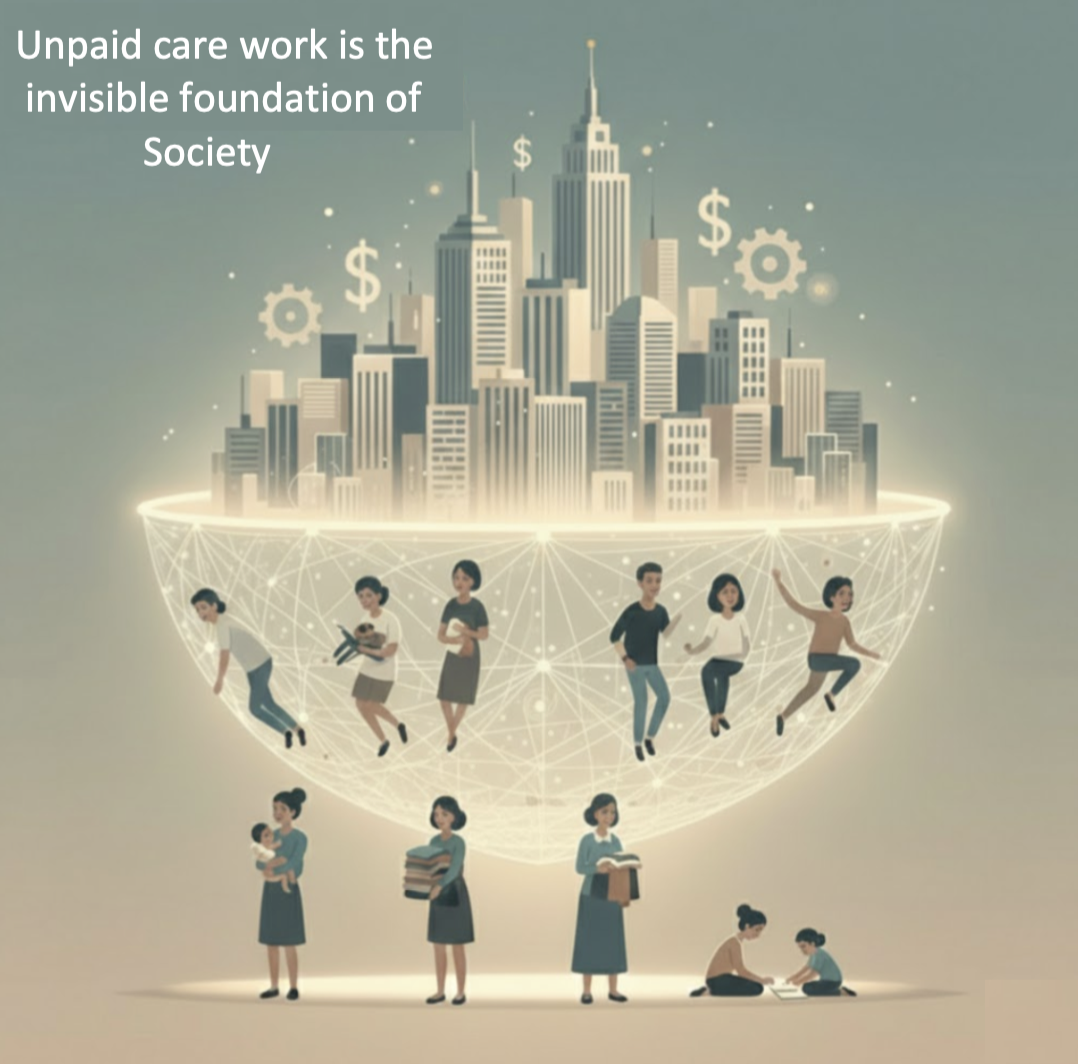
Unpaid care work remains invisible and unequally borne by women, creating time poverty that limits education and workforce participation across both developed and developing countries.
CareShift is a design-led framework that addresses unpaid care work as one of the deepest structural roots of gender inequality by redesigning how care is recognized, redistributed, and reduced within society. While women’s participation in education and employment has increased globally, progress remains constrained by the disproportionate burden of unpaid caregiving responsibilities that continue to fall on women and remain largely invisible within economic and institutional systems.
According to the International Labour Organization (ILO), women perform over 75% of unpaid care work globally and spend two to three times more hours on unpaid labor than men. This invisible contribution sustains households, communities, and national economies, yet remains excluded from GDP calculations, workforce planning, and social infrastructure design. As a result, millions of women experience persistent time poverty, limiting their ability to participate fully in education, paid work, skill development, and leadership pathways.
CareShift reframes unpaid care not as a private family issue, but as a design failure of social systems. The framework approaches care as a shared social function that can be intentionally designed, supported, and governed through coordinated interventions across households, communities, employers, and institutions.
How the CareShift System Works
CareShift operates through three interconnected design pillars, which function together as a continuous system rather than isolated interventions.
1. Recognition — Making Care Visible
The first breakdown in the care economy is invisibility. When care is not seen, it cannot be valued, planned for, or supported.
CareShift begins by designing mechanisms that make unpaid care work visible at multiple levels.
At the individual and household level, the framework introduces simple time-use recognition tools that allow caregivers to record daily hours spent on childcare, eldercare, household labor, and emotional support. These tools are designed to be visual, low-effort, and culturally adaptable, ensuring participation without burden.
At the community level, this data is translated into care maps that identify:
– households with high caregiving load
– peak care-demand periods
– communities facing eldercare or childcare gaps
These maps help local bodies and organizations understand where care pressure is concentrated, enabling targeted interventions rather than generic welfare responses.
At the institutional level, CareShift proposes formal acknowledgment mechanisms within schools, workplaces, and community programs. This includes recognition of caregiving responsibilities in participation requirements, attendance expectations, and engagement norms — legitimizing care work as real labor rather than personal inconvenience.
Through these steps, care becomes measurable, discussable, and visible — a prerequisite for systemic support.
2. Redistribution — Sharing Responsibility
Recognition alone is insufficient if responsibility remains concentrated on women.
CareShift therefore redesigns how care responsibility is distributed across society, shifting it from an assumed female role to a shared social function.
At the household level, the framework introduces shared-care planning systems that allocate caregiving tasks intentionally rather than by default. These include structured schedules, role rotation models, and responsibility mapping that normalize men’s participation through design, not moral persuasion.
At the community level, CareShift enables localized caregiving networks — small, trust-based groups that coordinate childcare, elder support, and emergency care. By pooling caregiving responsibilities within neighborhoods, the system reduces isolation and prevents individual overload.
At the institutional and employer level, the framework integrates care-support participation models, encouraging organizations to acknowledge caregiving constraints through flexible structures, care credits, or supported participation mechanisms. This extends responsibility beyond households into formal systems that benefit from women’s labor.
Through redistribution, care responsibility gradually shifts:
from individual women → to families → to communities → to institutions.
3. Reduction — Reducing Time Poverty
Even when care is visible and shared, the total time burden remains extremely high.
The ILO and UN Women consistently highlight that time poverty is one of the strongest barriers preventing women’s economic participation. CareShift therefore prioritizes reduction of care burden as a core design objective.
The framework introduces community care hubs that provide shared childcare, eldercare, and supervised care services within walking distance. These hubs reduce repetitive labor performed individually by each household and significantly lower daily care hours.
In parallel, CareShift promotes shared childcare and eldercare services that allow families to pool supervision and resources rather than duplicating effort.
The system also emphasizes time-saving infrastructure and proximity-based support, recognizing that access to water, sanitation, energy, and nearby services can reduce unpaid labor hours substantially — particularly in low-resource contexts.
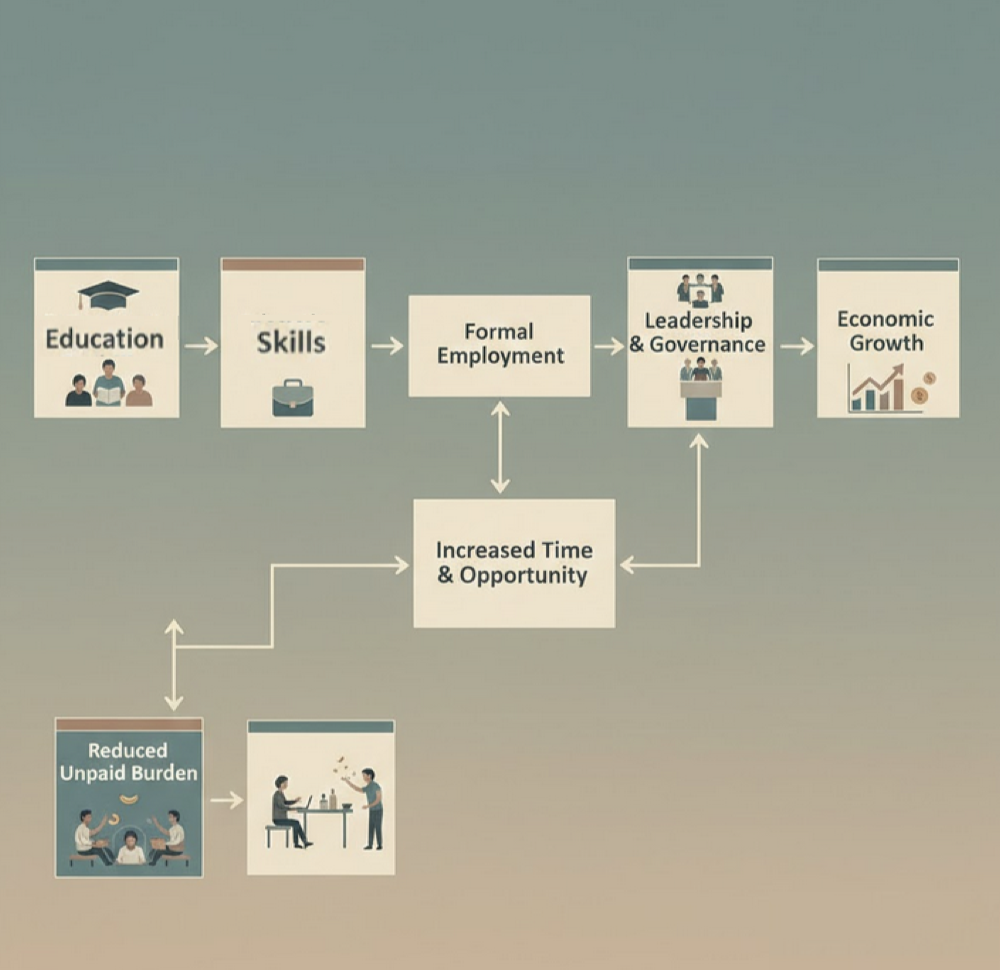
Even modest reductions of one to two hours per day, as highlighted in global time-use studies, can dramatically improve women’s capacity to:
-pursue education and skill development
-engage in paid employment
-participate in public and civic life
-sustain long-term leadership pathways
Systemic Impact
By integrating recognition, redistribution, and reduction into one cohesive framework, CareShift transforms unpaid care from an invisible burden into a designed social system.
The approach aligns with global development priorities identified by the ILO, UN Women, and World Bank, all of which emphasize that increasing women’s workforce participation — enabled by reducing unpaid care constraints — has the potential to significantly strengthen economic growth, productivity, and social resilience.
CareShift does not aim to eliminate care.
It aims to design care with dignity, fairness, and shared responsibility — enabling women to reclaim time, agency, and opportunity across life stages.
 CareShift.pdf